fbpx

Self-fulfilling prophecies

PredictionsSm


My medium of choice is science fiction.  People keep telling me that the things I write qualify as “hard” sci-fi, but through my eyeballs my work is still pretty lightweight compared to guys like Vinge, Gibson, Suarez and Brin.   Thing is though, most of the hard science fiction I’ve run across is “informed” fiction.  When you work in a medium that predicts the future, you have to have a touchstone in the now, a point where you and your reader can both stand upon before taking a step into what comes next.  As a writer it helps keep the tech from overriding the characters, as a reader it helps keep you from getting mindbogglingly lost.

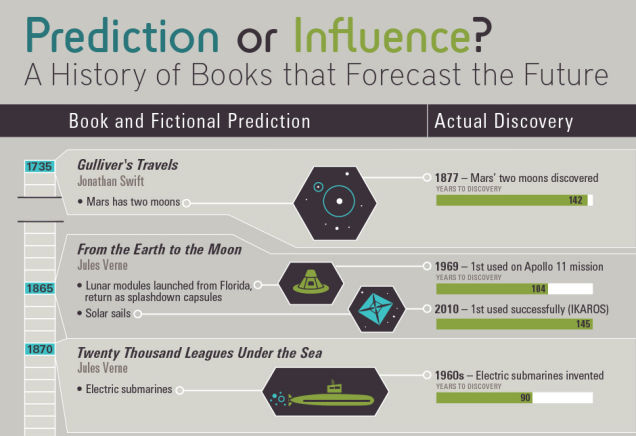
There are lots of posts running around nowadays about how this writer or that writer “predicted” the future, cel phones or satellites or touchscreens, but I think it’s a much more complex relationship than that, it’s rarely just some whiz-kid sitting in her parents basement imagining things to come.  See, writers ask questions, they read books, they say “hey I have this idea” and then they go hunt it up, or they go hunt up somebody who knows something about the idea (really, I find that cold-calling as a writer is a much easier thing to do than cold-calling was in my previous life as a stockbroker).

On the opposite side of that, we have the scientists, the ones who are talking to the writers, the ones who are reading the books that get written and saying “hey wouldn’t it be cool if you *could* make a rope out of buckyballs or a solar-powered exoskeleton”.  (Then as a third leg you get the artists and moviemakers who actually *visualize* this stuff so the investors and the public get all excited and chuck money at it).

So on the one hand, I love to see infographics like this, that point out how we are making our own futures.  How there was an idea, and then the science and funding and materials all came together to actually make that idea, that we, as humanity are guiding our own development (for better or worse).  On the other hand, I’m also very aware of how these kinds of things are not monolithic.  They are only very rarely the product of a single person, a single mind.  There’s conversations and brainstorming and questions and all kinds of information that flows from one individual to another until it achieves a kind of critical mass.

i09 has a great large-form copy of the graphic here for your perusal.
The Djinni and the Bottle

Person of Interest Logo S02

Person of Interest Logo S02


When the shows creators were quizzed about the reveal of PRISM (IRL) they mentioned that they were surprised by the relative non-reaction of the general populace here in the US.  The idea that citizens might not actually care all that much about the Govt. being able to play the ultimate peeping tom was not what they had expected.  Within the show, however, they finally seem to have found their new footing.

See, there is this psychological barrier, this “djinni in a bottle” effect that we have with regards to technology and scientific effort.  You often have several groups all pushing towards the same goal, be it the splitting of the atom, the development of wearable technologies, the creation of a shampoo that doesn’t sting when it gets in your eyes, and they can often run neck and neck when it comes to approaching the finish line.  Oftentimes everyone hits a wall and the research just spins its wheels for a few years (or decades).

But eventually someone breaks through.  Sometimes it’s a newcomer with deep pockets backing a new team (like Google with Glass) sometimes it’s a team that’s been working on solving the problem for years and a piece of new research or tech kicks them over into the winner’s circle. But in almost all cases, once that barrier has been broken, once one person or team has made the discovery, more follow, and usually swiftly.

But the tragic thing is that oftentimes, the group that makes the discovery, who breaks the barrier first is not the group that survives.  They are not the ones who figure out how to use the technology, or turn it into a viable product.  Sometimes they get crushed and bought up by a company that played it safer, or a group that came late to the party, sometimes the discovery sits idle for years.

In POI, that djinni is now well and truly out of the bottle.  Rather than trying to recruit Finch and his team, the Desima group has simply gone around, acquiring a parallel technology and preparing to crush (in a very literal fashion) any and all competitors.  We are looking at the difference in mindset between Finch (who proposed the Machine as a Shield, as a defensive tool) and Desima (who is interested only in the business of running the world).  Historically, IRL, the groups who are more business minded generally come out the winners.  I’m looking forward (perhaps apprehensively) to seeing how POI’s creators resolve this conflict in their own (already eerily predictive) created universe.

********

A last note, y’all may have noticed that I keep the comments closed on this blog.  I am, however, always willing to talk about any of these posts, so come find me on G+ if you like.  The blog is perpetually fighting SPAM posts (even with CAPTCHA and other safeguards in place) so I keep the comments closed.